


Practice Examples and Dumps & Tips for 2026 Latest CTAL_TM_001 Valid Tests Dumps
Latest [Mar 01, 2026] 100% Passing Guarantee - Brilliant CTAL_TM_001 Exam Questions PDF
For more info visit:
Difficulty in writing the CTAL-TM Exam
As all people know about this fact that CTAL-TM exam is not easy to pass because it requires a lot of efforts and a dependable and latest study material to efficiently pass the exam. Many Candidates have doubts in their mind before writing the Cisco Understanding CTAL-TM certification exam that is a pattern of the test, the types of questions asked in it and the difficulty level of the questions and time required to complete the questions. The best way to pass CTAL-TM exam is to challenge and improve knowledge. Candidates test their learning and identify improvement areas with actual exam format. The best solution is to practice with CTAL-TM Certification Practice Exam because the practice test is one of the most important elements of CTAL-TM exam study strategy in which Candidates can discover their strengths and weaknesses to improve time management skills and to get an idea of the score that they can expect. Prep4sureGuide offers the latest exam questions for the CTAL-TM Exam which can be understood by the candidates deprived of any difficulty. Our 210-250 exam dumps study material is best-suited to busy professionals who don't have much to spend on preparation and want to pass it in a week. Our CTAL-TM practice exam has been duly prepared by the team of experts after an in-depth analysis of Cisco recommended syllabus. We update our material regularly. So, it is intended to keep candidates updated because as and when Cisco will announce any changes in the material; we will update the material right away. After practicing with our CTAL-TM exam dumps Candidate can pass CTAL-TM exam with good grades.
NEW QUESTION # 121
You are monitoring the test results for the first week of system test execution to ensure they conform to the test plan objectives. You are guided by the list of test conditions and traceability matrix produced following test design. Test Plan objectives
* Approach - Risk-based and depth first
* Status reporting - Execution statuses must be either "Passed*, "Failed", "Blocked" or "Not Run"
* Traceability - Test execution results must be traceable back to the test conditions Test Conditions
Traceability matrix
Which one of the following is a correct statement regarding the current status of test plan objectives?
SELECT ONE OPTION
- A. None of the objectives have been met.
- B. All objectives have been met.
- C. Only Approach and Traceability objectives have been met.
- D. All the Traceability objective has been met.
Answer: D
NEW QUESTION # 122
In what environment are you most likely to see multiple defect management systems used in one project?
- A. Agile
- B. Hybrid
- C. Multi-tenant
- D. Sequential
Answer: B
Explanation:
* Context Analysis:
* A hybrid environment combines methodologies (e.g., Agile and traditional), often leading to multiple tools to manage different workflows, methodologies, or team needs.
* Evaluation of Options:
* A. Sequential:
* Incorrect. Sequential approaches usually involve a single defect management system due to their linear nature.
* B. Agile:
* Incorrect. Agile projects often emphasize a single integrated tool for simplicity and collaboration.
* C. Hybrid:
* Correct. Multiple tools are typical in hybrid models to accommodate diverse team processes.
* D. Multi-tenant:
* Incorrect. Multi-tenancy relates to shared infrastructure, not the use of defect management systems.
* Syllabus Alignment:
* ISTQB mentions hybrid approaches leading to diverse tool requirements for managing defects across different methodologies (TM-1.2.4).
References:
ISTQB Advanced Level Test Management Syllabus (TM-1.2.4)
NEW QUESTION # 123
Consider the following metrics:
a Percentage of all product risks identified during initial risk analysis b. Average time taken by developers to fix defects for each severity level c. Statement coverage achieved by the component test suite d. Breakdown of defects detected by test level How many of the five primary dimensions for test progress monitoring have been addressed by these metrics?
SELECT ONE OPTION
- A. 0
- B. 1
- C. 2
- D. 3
Answer: C
NEW QUESTION # 124
Which of the following team roles would be most appropriate to enhance the team and why? 2 credits
- A. A person with the ability to complete tasks
- B. A person with in-depth technical skills
- C. A person who brings new ideas to the team
- D. A quality assurance officer
Answer: C
Explanation:
Explanation/Reference:
Explanation:
NEW QUESTION # 125
The test team is using a distributed model for testing.
What is the primary factor you should consider with this model? [1]
- A. Planned vs. actual hours
- B. Provision of growth opportunities for the individual testers
- C. Co-location of test team
- D. Alignment of methodologies
Answer: D
Explanation:
A distributed model for testing is a testing model that involves testers working in different locations, time zones, or organizations, such as onshore, offshore, or nearshore1. The primary factor that you should consider with this model is the alignment of methodologies, which means that the testers follow the same or compatible testing processes, standards, tools, and techniques, regardless of their location, time zone, or organization2. The alignment of methodologies can help to ensure the consistency, quality, and efficiency of the testing activities, as well as to facilitate the communication, coordination, and collaboration among the testers3. Therefore, option A is the correct answer. Option B is incorrect because co-location of test team is not a factor that you should consider with a distributed model for testing, but rather a factor that is contrary to a distributed model for testing. Co-location of test team means that the testers work in the same physical location, which can have some advantages, such as easier communication, faster feedback, and stronger team spirit, but also some disadvantages, such as higher costs, limited resources, and less diversity4. Option C is incorrect because provision of growth opportunities for the individual testers is not a factor that you should consider with a distributed model for testing, but rather a factor that is relevant to any testing model. Provision of growth opportunities for the individual testers means that the testers are given the chance to learn new skills, gain new experiences, and advance their careers, which can have some benefits, such as increased motivation, productivity, and retention of the testers. Option D is incorrect because planned vs. actual hours is not a factor that you should consider with a distributed model for testing, but rather a factor that is relevant to any testing model. Planned vs. actual hours is a testing metric that compares the estimated and the actual effort spent on the testing activities, which can help to measure the accuracy of the test estimation, the efficiency of the test execution, and the variance of the test schedule. Reference: 1: ISTQB Glossary, Distributed Testing 2: Distributed Testing - Software Testing Fundamentals 3: ISTQB Advanced Level Test Manager Syllabus, Section 3.2.1 4: Co-located vs. Distributed Teams: What's the Difference? : How to Provide Growth Opportunities for Employees : Software Testing Metrics: What is, Types & Example
NEW QUESTION # 126
Which of the following are primary activities in conducting product risk analysis? [1]
- A. Risk testing, risk management
- B. Risk identification, risk testing
- C. Risk identification, risk assessment
- D. Risk management, risk assessment
Answer: C
Explanation:
Product risk analysis is the process of identifying and assessing the product risks that may affect the quality or functionality of the software under test1. Product risk analysis involves two primary activities: risk identification and risk assessment. Risk identification is the activity of finding, naming, and describing the risks that might affect the software under test2. Risk assessment is the activity of estimating the impact and probability of occurrence (likelihood) of the identified risks, and prioritizing them based on these factors3. Therefore, option B is the correct answer. Option A is incorrect because risk testing and risk management are not primary activities of product risk analysis, but rather activities that follow or use the results of product risk analysis. Risk testing is the activity of designing, implementing, and executing tests based on the product risk levels to reduce the level of product risks and inform stakeholders of their status4. Risk management is the activity of planning, monitoring, and controlling the risks and the risk mitigation actions in the software project5. Option C is incorrect because risk identification and risk testing are not primary activities of product risk analysis, but rather activities that are part of product risk analysis and risk-based testing respectively. Option D is incorrect because risk management and risk assessment are not primary activities of product risk analysis, but rather activities that are part of risk management and product risk analysis respectively. Reference: 1: ISTQB Glossary, Product Risk Analysis 2: ISTQB Glossary, Risk Identification 3: ISTQB Glossary, Risk Assessment 4: ISTQB Glossary, Risk-Based Testing 5: ISTQB Glossary, Risk Management : Product Risk Analysis (PRA) | TMap : Risk-Based Testing | ISTQB Glossary : Risk Analysis | ISTQB Glossary
NEW QUESTION # 127
Your team has decided that they will build their own test management tool This will allow them to link the requirements and test cases together providing full traceability It will also allow them to create fully customized reporting and color-coded dashboards They have estimated the time required to create the new tool and the cost These fit within the project schedule and budget What other consideration should be taken before this decision is made?
- A. Licensing fees to other parts of the organization
- B. Maintenance costs
- C. Relative benefits to your vendors
- D. Reduction of manual repetitive testing
Answer: B
Explanation:
* Context Analysis:
* Building a custom tool may address traceability and customization needs, but ongoing costs such as maintenance are critical for sustainable implementation.
* Evaluation of Options:
* A. Relative benefits to your vendors:
* Incorrect. Vendor benefits are not directly relevant if the decision is to build an internal tool.
* B. Maintenance costs:
* Correct. Maintenance includes long-term support, updates, and potential scalability, essential considerations for internally developed tools.
* C. Licensing fees to other parts of the organization:
* Incorrect. The question assumes the tool is internally built, so external licensing fees do not apply.
* D. Reduction of manual repetitive testing:
* Incorrect. While desirable, this is an indirect benefit and not the primary focus of decision- making in tool development.
* Syllabus Alignment:ISTQB syllabus emphasizes the need to evaluate long-term costs (e.g., maintenance) when adopting or developing tools (TM-1.6.2).
References:
ISTQB Advanced Level Test Management Syllabus
NEW QUESTION # 128
In addition to introducing the new team member, you have decided to raise motivation. Which of the measures listed below would be the best measure to take in order to increase the motivation of the team? 2 credits
- A. Allow people to take some time off
- B. Introduce entry criteria to the testing phase
- C. Organize a meeting with senior management in which they address the importance of good testing for this project
- D. Provide more time for testing in the schedule
Answer: C
Explanation:
Explanation/Reference:
Explanation:
NEW QUESTION # 129
Which of the following statements is true regarding Fault Tree Analysis? [1]
- A. It is used to determine the root cause of observed and potential failures.
- B. It is used to target defect-based testing.
- C. It is a formal technique used to identify the likely effects of risks.
- D. It is used to select the pairs of items to be used in pairwise testing.
Answer: A
Explanation:
Fault Tree Analysis (FTA) is a technique used to analyze the causes of faults (defects). The technique visually models how logical relationships between failures, human errors, and external events can combine to cause specific faults to disclose1. FTA can help to determine the root cause of observed and potential failures by tracing back the fault events to their initiating causes and identifying the combinations of events that can lead to the fault occurrence2. Therefore, option A is the correct answer. Option B is incorrect because FTA is not used to select the pairs of items to be used in pairwise testing, which is a technique to generate test cases based on the combinations of two input parameters. Option C is incorrect because FTA is not a formal technique used to identify the likely effects of risks, which are uncertain events or conditions that may have a positive or negative impact on the project objectives. Option D is incorrect because FTA is not used to target defect-based testing, which is a testing technique that uses information about the types, causes, and locations of defects discovered in previous projects to guide the selection, creation, and prioritization of test cases. Reference: 1: Fault Tree Analysis | ISTQB Glossary 2: Fault Tree Analysis (FTA) - Software Testing Genius : ISTQB Glossary, Pairwise Testing : ISTQB Glossary, Risk : ISTQB Glossary, Defect-Based Test Technique : Fault Tree Analysis (FTA) - Software Testing Genius : Fault Tree Analysis | ISTQB Glossary
NEW QUESTION # 130
While mining the defect database for patterns of problems in the last release, a Test Manager notices that many of the most damaging failures were caused by defects injected during the low-level design phase.
Which of the following actions will likely give this project the most effective solution to this problem? [3]
- A. Formal inspections of the code modules affected by the last release
- B. Increased white-box coverage during system testing
- C. Increased static analysis during the implementation phase
- D. Mandatory reviews of all important design work products
Answer: D
Explanation:
The most effective solution to this problem is to implement mandatory reviews of all important design work products. This is because reviews are a type of static testing technique that can detect and prevent defects early in the software development lifecycle, before they become more costly and difficult to fix. By reviewing the low-level design work products, such as detailed design specifications, the project team can ensure that they are consistent, complete, and correct, and that they meet the requirements and the quality standards. Reviews - ISTQB not-for-profit association Reference: Certified Tester Advanced Level Test Manager (CTAL-TM) - ISTQB not-for-profit association, ISTQB Test Manager Certification - ISTQB Exams Worldwide - ISTQB Official Registration, Reviews - ISTQB not-for-profit association
NEW QUESTION # 131
You have assembled the following cost of quality numbers 200 defects were found prior to release and 100 were found after.
Given this information what is the total cost of quality for this project?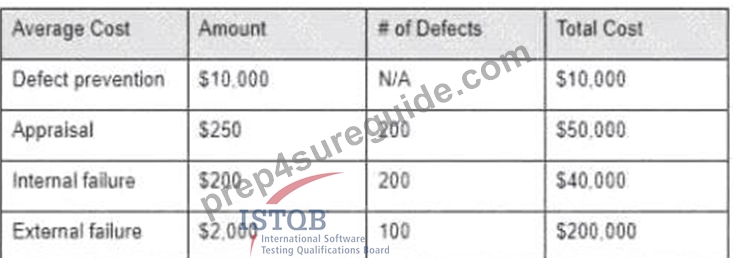
- A. $10 000
- B. $300,000
- C. $200,000
- D. $100,000
Answer: B
Explanation:
Step by Step Comprehensive Detailed Explanation:
* Definition of Cost of Quality (CoQ):CoQ is composed of four components:
* Prevention Costs:Costs related to activities to prevent defects (e.g., training, quality planning).
* Appraisal Costs:Costs associated with evaluating products to ensure defect-free delivery (e.g., testing).
* Internal Failure Costs:Costs due to defects found before delivery to the customer (e.g., rework).
* External Failure Costs:Costs from defects discovered after delivery (e.g., warranty claims, reputation damage).
* Calculation Process:
* Defect Prevention Cost:Given as $10,000 (fixed).
* Appraisal Cost:$250 per defect for 200 defects = 250×200=50,000250 \times 200 = 50,000250
×200=50,000.
* Internal Failure Cost:$200 per defect for 200 defects = 200×200=40,000200 \times 200 =
40,000200×200=40,000.
* External Failure Cost:$2,000 per defect for 100 defects = 2,000×100=200,0002,000 \times 100
= 200,0002,000×100=200,000.
* Total CoQ:Adding all costs together:
Total CoQ=10,000+50,000+40,000+200,000=300,000.\text{Total CoQ} = 10,000 + 50,000 + 40,000 +
200,000 = 300,000.Total CoQ=10,000+50,000+40,000+200,000=300,000.
* Correct Answer and Justification:The total cost is$300,000, making Option A the correct answer.
References and Documentation from Advanced Test Management:
* ISTQB Advanced Test Management Syllabus v3.0, Section 2.2.2:This section emphasizes understanding and calculating the cost of quality by segregating it into the four components as seen above.
* ATM Sample Exam Questions 2024 (Example Calculations):Highlights similar numerical examples to calculate CoQ.
* ISTQB Exam Structure Rules v1.9:Ensures alignment with K2-level understanding for cost analysis scenarios in test management.
NEW QUESTION # 132
Which of the following Is the common set of information to be produced in a test estimate''
- A. Number of people number of systems lines of code, cost
- B. Time per person budget end date start date
- C. Test effort test duration time to complete, cost
- D. Effort time cost, test activities
Answer: D
Explanation:
* Key Factors in Test Estimation:
* Test estimation requires identifying measurable factors that influence the testing process, includingeffort(workload in person-hours),time(calendar duration),cost, and thespecific test activities(e.g., planning, design, execution).
* These are critical to align resources and schedules, ensuring effective project management.
* Evaluation of Options:
* Ais incorrect: While "lines of code" may relate to testing scope in specific cases, it is not universally applicable in test estimation.
* Bis incorrect: "Start and end dates" are outputs of planning, not estimation.
* Cis partially correct but lacks a focus on "test activities," which is crucial for completeness.
* Dis correct as it covers effort, time, cost, and test activities, reflecting a comprehensive test estimate.
References and Syllabus Alignment:
* As per ISTQB Advanced Test Management syllabus, test estimation should consider effort, time, cost, and activities under "Test Planning" (TM-1.1.1).
NEW QUESTION # 133
The introduction of reviews and inspections has often failed as a process improvement action. Identify the THREE most important measures that should be taken to reduce the risk that this test process improvement will fail. 2 Credits (for 2 out of 3 correct 1 credit)
- A. Training of those involved
- B. Usage of a more traditional software development lifecycle
- C. Alignment with software process improvement
- D. Process ownership and experienced moderators who drive the inspection process.
- E. The availability of stands and processes
- F. Management support
- G. Using a reference model, e.g. TMMi
Answer: A,D,F
NEW QUESTION # 134
Which work experience is likely to develop the necessary skills to effectively test a software system? [3]
- A. Being the current Project Manager for the system
- B. Being a former Test Manager
- C. Being the developer of testing tools used for automation
- D. Being a member of the production group that supported the previous release of the system
Answer: C
Explanation:
Being the developer of testing tools used for automation is likely to develop the necessary skills to effectively test a software system because it involves a deep understanding of testing processes and the creation of tools that facilitate these processes. This experience provides insight into the intricacies of test automation, which is crucial for designing effective tests and ensuring thorough coverage of the system under test.
NEW QUESTION # 135
You are a Test Manager on a new project. The software that is being created will be used to control the projectors in movie theaters. This is a time critical project because the software must be released before the Christmas holiday season which has the highest movie attendance of the year.
You have decided to implement a review process for the work products that are a part of this release to save both time and money. In order to expedite the training, you brought in a consultant to train the participants and moderators in proper review processes. Your team is enthusiastic about participating in the reviews.
Your manager is questioning the money you have spent on this training effort. He wants to know how you intend to justify the expense when you present your numbers at the annual budget meeting in February.
What would be a reasonable way for you to justify the cost of the training and the reviews when you present your information at the budget meeting? [3]
- A. Show the defects that were found in the review sessions and show the cost of quality regarding the perfect phase containment for those caught defects.
- B. Explain that the reviews are a way of expanding the knowledge of your people and will motivate them to work harder and faster, thus saving money for the company.
- C. Compare the production defects from the previous project to the production defects from this project and explain the cost benefits due to the defect reduction in production.
- D. Calculate the ROI using the difference between the cost of the reviews and the cost of dealing with defect escapes.
Answer: D
Explanation:
The cost of the training and the reviews can be justified by showing the return on investment (ROI) that they generate. ROI is a measure of the profitability of an investment, calculated by dividing the net benefit by the cost1. The net benefit of the training and the reviews is the difference between the cost of the reviews and the cost of dealing with defect escapes. Defect escapes are defects that are not detected during the review process and are found later in the development or testing phases, or even in production. The cost of dealing with defect escapes includes the cost of rework, testing, debugging, deployment, customer support, and potential loss of reputation or revenue2. The cost of the reviews includes the cost of the training, the time spent by the reviewers and moderators, the tools and resources used, and the overheads3. By calculating the ROI, you can demonstrate how much money the training and the reviews have saved or earned for the company, compared to the alternative of not conducting them. Therefore, option D is the correct answer. Option A is incorrect because comparing the production defects from the previous project to the production defects from this project does not account for the cost of the reviews or the cost of dealing with defect escapes in other phases. Option B is incorrect because showing the defects that were found in the review sessions and the cost of quality regarding the perfect phase containment for those caught defects does not account for the cost of the training or the cost of dealing with defect escapes in production. Option C is incorrect because explaining that the reviews are a way of expanding the knowledge of your people and motivating them to work harder and faster is not a quantifiable or verifiable way of justifying the cost of the training and the reviews. References: 1:
ISTQB Glossary, Return on Investment 2: ISTQB Advanced Level Test Manager Syllabus, Section
2.3.2 3: How to manage formal reviews & management audits? Skills, metrics ...
NEW QUESTION # 136
Refer to SCENARIO 1
Week 4 of test execution has been completed and the following test report has been produced
Review this report against the organisational Test Strategy, what is the status of the Test Strategy objectives? SELECT ONE OPTION
- A. Test strategy objective 2 and 3 have been met. Test strategy objective 1 has NOT been met.
- B. Test strategy objective 1 and 3 have been met. Test strategy objective 2 has NOT been met.
- C. Test strategy objective 1. 2 and 3 have been met
- D. Test strategy objective 1 and 2 have been met. Test strategy objective 3 has NOT been met.
Answer: B
NEW QUESTION # 137
Which of the following statements is true regarding Fault Tree Analysis?
- A. It is used to determine the root cause of observed and potential failures.
- B. It is used to target defect-based testing.
- C. It is a formal technique used to identify the likely effects of risks.
- D. It is used to select the pairs of items to be used in pairwise testing.
Answer: A
Explanation:
Fault Tree Analysis (FTA) is a technique used to analyze the causes of faults (defects). The technique visually models how logical relationships between failures, human errors, and external events can combine to cause specific faults to disclose1. FTA can help to determine the root cause of observed and potential failures by tracing back the fault events to their initiating causes and identifying the combinations of events that can lead to the fault occurrence2. Therefore, option A is the correct answer. Option B is incorrect because FTA is not used to select the pairs of items to be used in pairwise testing, which is a technique to generate test cases based on the combinations of two input parameters. Option C is incorrect because FTA is not a formal technique used to identify the likely effects of risks, which are uncertain events or conditions that may have a positive or negative impact on the project objectives. Option D is incorrect because FTA is not used to target defect-based testing, which is a testing technique that uses information about the types, causes, andlocations of defects discovered in previous projects to guide the selection, creation, and prioritization of test cases. References: 1: Fault Tree Analysis | ISTQB Glossary 2: Fault Tree Analysis (FTA) - Software Testing Genius : ISTQB Glossary, Pairwise Testing : ISTQB Glossary, Risk : ISTQB Glossary, Defect-Based Test Technique : Fault Tree Analysis (FTA) - Software Testing Genius : Fault Tree Analysis | ISTQB Glossary
NEW QUESTION # 138
Which of the following Is the common set of information to be produced in a test estimate''
- A. Number of people number of systems lines of code, cost
- B. Time per person budget end date start date
- C. Test effort test duration time to complete, cost
- D. Effort time cost, test activities
Answer: D
Explanation:
Key Factors in Test Estimation:
Test estimation requires identifying measurable factors that influence the testing process, including effort (workload in person-hours), time (calendar duration), cost, and the specific test activities (e.g., planning, design, execution).
These are critical to align resources and schedules, ensuring effective project management.
Evaluation of Options:
A is incorrect: While "lines of code" may relate to testing scope in specific cases, it is not universally applicable in test estimation.
B is incorrect: "Start and end dates" are outputs of planning, not estimation.
C is partially correct but lacks a focus on "test activities," which is crucial for completeness.
D is correct as it covers effort, time, cost, and test activities, reflecting a comprehensive test estimate.
Reference and Syllabus Alignment:
As per ISTQB Advanced Test Management syllabus, test estimation should consider effort, time, cost, and activities under "Test Planning" (TM-1.1.1).
NEW QUESTION # 139
Which one of the following estimation approaches is appropriate at this stage of the project? 2 credits
- A. Create an estimate based on the complexity of the code
- B. Create an estimate based on the function point analysis technique and test point analysis
- C. Create an estimate based on the credentials of the successful bidder
- D. Create an estimate based on a percentage of the development effort
Answer: B
NEW QUESTION # 140
Your team has been assigned to a new project You have a mix of manual testers and automation engineers but everyone is currently doing manual testing. The development learn has alreadydecided to use DevOps as its approach but they have never used it before and are happy to take your input Unfortunately, about 50% of the development is completed already In the testing your team is doing they are finding that about 40% of the defects they catch are actually regressions caused by other changes Given this information what should you do to help mitigate risk'?
- A. Optimize the test environment to provide faster testing with more accurate test data and better testing tools to provide wider coverage
- B. Pivot part of the team from manual testing to test automation development to address the regression risk and implement better quality gates to reduce regressions
- C. Implement code reviews for the development team and require tester signoff before code can be released into the pipeline
- D. Review the policies regarding defect reporting and ensure your team is adding all the necessary information to each defect report
Answer: B
Explanation:
* Identifying the Risk:
* High regression rates (40%) indicate a need to improve regression testing capabilities and reduce risks.
* Test automation addresses regressions effectively by enabling faster and repeated testing.
* Evaluation of Options:
* Ais irrelevant to the regression risks highlighted.
* Bis correct because it emphasizes test automation for regressions and quality gates to prevent defect leaks.
* Cis partially valid but does not directly address regression issues.
* Dfocuses on development practices, which, while helpful, does not directly reduce regression risks.
References and Syllabus Alignment:
* This aligns with ISTQB guidelines on balancing manual and automated testing in regression scenarios (TM-1.6.3, TM-1.4.2).
NEW QUESTION # 141
......
CTAL-TM Certified Professional Salary
- Europe:€66508
- England: £56673
- United States: $73,763
- India:₹524039
CTAL_TM_001 are Available for Instant Access: https://examcollection.prep4sureguide.com/CTAL_TM_001-prep4sure-exam-guide.html